Local governments and national authorities in Kyrgyzstan are developing more effective regional development plans under a new state programme developed with support from the UK Government. The new approach is helping local authorities use evidence, economic forecasts and the priorities of businesses and communities to plan for stronger and more inclusive local economic development.
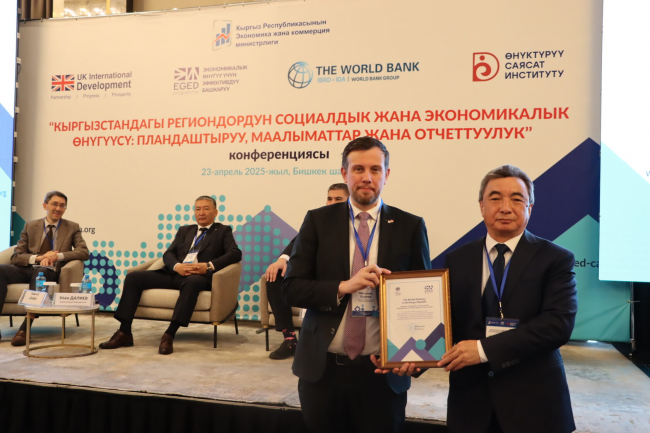
The implementation of the State Programme for the Socio-Economic Development of the Regions of Kyrgyzstan until 2030 was the focus of a conference held in Bishkek on 23 April. The programme was developed with support from the Effective Governance for Economic Development (EGED) programme, funded by the UK Government and implemented by the Development Policy Institute.
The State Programme builds on extensive work to introduce new approaches to local development planning and forecasting, based on data and the priorities of businesses and local communities.
Participants highlighted that, with support from EGED, thousands of national and municipal officials have learned to apply new planning and forecasting methods. This is enabling local authorities to develop more effective socio-economic development programmes that better reflect local economic opportunities, challenges and community needs.
Representatives of district administrations noted that the new approaches introduced with EGED support have improved their ability to forecast economic growth and changes affecting vulnerable groups. They have also strengthened cooperation between ayil okmotu (local self-government bodies), district administrations, businesses and local communities.
District Coordination Councils have played an important role in this process. Under the new planning methodology, they have become a mandatory platform for dialogue at district level, bringing together local government, businesses and communities to identify priorities and work jointly on local development. This creates stronger links between public planning and the needs of local economies, helping local authorities make better-informed decisions that can support economic activity and improve opportunities for communities.
First Deputy Minister of Economy and Commerce Choro Seyitov said that the State Programme would strengthen the management of regional development, contribute to economic growth and help improve people's quality of life. He also highlighted the effectiveness of District Coordination Councils and the role of the EGED programme in developing the document.
“Across the world, local authorities play an important role in delivering public services to citizens and supporting economic development. One important similarity between our countries in local governance is the value of decentralisation, because it empowers local communities. The EGED programme has been an excellent example of successful cooperation between our countries, bringing together local authorities, entrepreneurs, civil society and the media to work towards a common goal”, said UK Ambassador Nicholas Bowler.
The conference brought together more than 100 representatives of government ministries, local authorities, experts, academics and international partners. It was organised by the Ministry of Economy and Commerce together with the Development Policy Institute under the EGED programme, with support from the UK Government.
***
EGED is a five-year UK Government-funded technical assistance programme in Central Asia. It aims to improve the effectiveness of economic policy in Kazakhstan, Kyrgyzstan, Tajikistan and Uzbekistan by embedding evidence-based approaches in the planning and implementation of government reforms. The programme also supports civil society in Kyrgyzstan, Tajikistan and Uzbekistan to help governments make better use of evidence — an important foundation for more effective and accountable governance and, ultimately, stronger and more inclusive economic development.