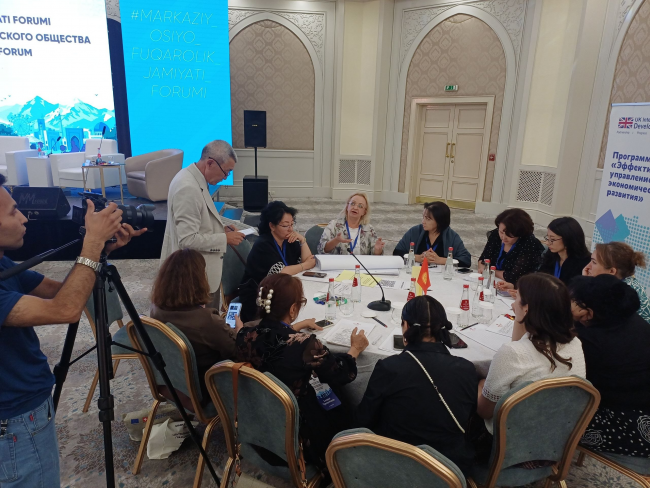
The Effective Governance for Economic Development Programme (EGED), funded by the Government of the United Kingdom, in cooperation with the Government of Switzerland through the Swiss Agency for Development and Cooperation created a platform for the first regional study on the contribution of civil society organizations to the development of Central Asian countries, as well as for open dialogue among government institutions, civil society, the expert community and international partners. This made it possible, for the first time at the regional level, to present an evidence-based assessment of the role of civil society in the socio-economic development of the region and to discuss joint approaches to addressing common challenges.
On 25 June 2026, the regional conference “The Contribution of Civil Society to the Well-being of Central Asian Countries: Facts, Forecasts and Joint Initiatives” was held in Tashkent. The event was organized by the Yuksalish Movement of Uzbekistan in partnership with the Development Policy Institute of Kyrgyzstan, on the platform of the Central Asian Civil Society Forum (CACSF), within the framework of the EGED Programme.
The key outcome of the conference was the presentation of the first regional study[1], which made it possible to assess the contribution of civil society organizations not only through the number of implemented projects and the volume of attracted funding, but also through their impact on the economy, employment, the quality of public governance and the sustainable development of Central Asian countries. The study covered Kazakhstan, Kyrgyzstan, Tajikistan, Turkmenistan and Uzbekistan and was based on the analysis of statistical data, national reports, expert interviews, focus groups and successful practices.
The findings show that more than 56,000 civil society organizations are registered in Central Asian countries, with around 18,600 of them actively operating. The sector employs approximately 193,000 people, its annual financial inflows exceed USD 4.2 billion, and more than 1.5 million people across the region receive support and services from civil society organizations every year. Further details are available by the link: https://www.facebook.com/share/p/1Bkuf4d32G/
The study also demonstrated different models of civil society contribution across the countries of the region. In Kyrgyzstan, a system has been developed to assess institutional contribution through employment, tax revenues and gross value-added indicators. Kazakhstan has a well-developed system of state social contracting. Uzbekistan is actively strengthening institutional support for the sector. In Tajikistan, civil society organizations are involved in inter-agency working groups and decision-making processes. In Turkmenistan, a significant part of civil society activity is integrated into the implementation of state social programmes.
The second part of the conference focused on identifying joint solutions in five areas: citizen participation in development and governance; economic development of communities; cooperation with the private sector; empowerment of women and youth; and adaptation of local communities to climate change. Participants developed proposals for strengthening regional cooperation and shaping joint initiatives in the context of the implementation of the “Central Asia – 2040” Concept.
As a result of the discussions, participants confirmed that civil society is an important actor in the socio-economic development of the region. They also emphasized the need to improve systems for assessing the contribution of civil society organizations, expand their participation in the development of public policies, increase the openness of statistical data and develop regional cooperation mechanisms. One of the key recommendations was to continue building a unified regional platform for exchanging experience, conducting joint research and promoting successful practices of civic participation in Central Asian countries.
As noted by Nadezhda Dobretsova, Chairman of the Board of Development Policy Institute, Head of the Research Author Group: “We sought to present civil society not only through projects and grants, but as a full-fledged development actor. The study confirmed that civil society organizations create jobs, provide services, generate expert solutions and make a significant contribution to the quality of governance and the sustainability of development in Central Asian countries”.
Representative of the Yuksalish Movement, emphasized the importance of further strengthening partnerships: “For the further development of the region, it is important not only to recognize the contribution of civil society, but also to create conditions for its expansion. Today, Central Asia needs new formats of cooperation between the state, business and civil society, based on trust, openness and shared responsibility for the future of the region”.
The conference became an important step towards forming a common regional understanding of the role of civil society in the sustainable development of Central Asia and confirmed the potential for further cooperation among government institutions, civil society organizations and international partners.
_____________
[1] The full version of the regional study can be accessed on the Development Policy Institute (DPI) website: https://dpi.kg/en/library/full/403.html and on the Yuksalish Movement website: https://yuksalish.org/files/other/NGO_CA_Report_RUS.pdf.