Bishkek, Kyrgyz Republic – 12 June 2026
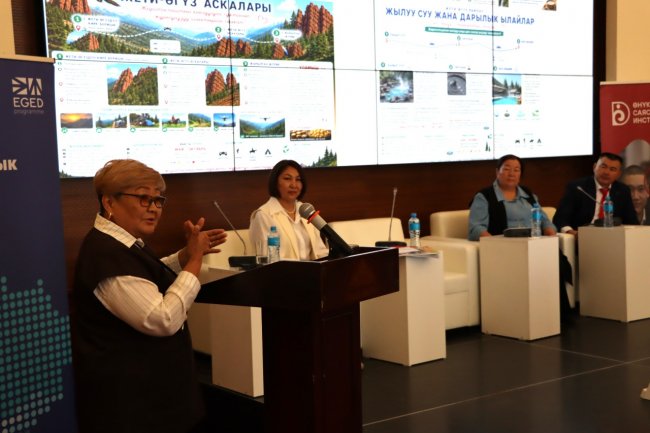
The Ministry of Economy and Commerce of the Kyrgyz Republic convened the final conference, “Social and Economic Development of Regions in Kyrgyzstan: Planning, Data, and Accountability,” to present the results of the Effective Governance for Economic Development (EGED) Programme.
Implemented by the Development Policy Institute with the support of the Government of the United Kingdom, the programme has helped strengthen evidence-based regional development planning and investment management in seven pilot districts across Kyrgyzstan.
The conference brought together representatives of national and local authorities, development partners, the private sector, and civil society to discuss practical approaches to local economic development based on data, strategic planning, and multi-stakeholder cooperation.
The EGED Programme introduced innovative tools and approaches in the pilot districts of At-Bashy, Kemin, Aitmatov, Jeti-Oguz, Bazar-Korgon, Nookat, and Kadamjay. These included data-driven socio-economic development planning, territorial investment profiles, forecasting mechanisms, and Coordination Councils serving as platforms for dialogue among local authorities, businesses, and civil society organizations.
According to programme results, approximately 2,600 new jobs were created in the pilot districts by the end of 2025. Current projections estimate that more than 17,500 jobs could be generated by 2030. Improved investment management processes are expected to contribute to additional economic growth, with projected household income increases ranging from 50 to 60 percent in some districts. The estimated cumulative economic impact of systemic improvements in local investment governance is projected to reach KGS 83.6 billion.
Speaking at the conference, Iskandarbek Mamatov, Head of the Regional Development Policy Department at the Ministry of Economy and Commerce, highlighted the growing opportunities for regional development in Kyrgyzstan and emphasized the importance of effective engagement with both domestic and international investors.
“The pilot districts of the EGED Programme demonstrate how local governments can proactively remove barriers, present investment opportunities, and build productive dialogue with investors. Their experience provides valuable lessons for replication across the country”, he noted.
Concrete results are already contributing to increased investment attraction and local economic growth. In Jeti-Oguz district, investment forums facilitated the signing of cooperation memoranda worth approximately USD 600 million. Kemin district has developed an investment portfolio comprising 115 projects, while At-Bashy district has strengthened the development of priority economic clusters.
Addressing participants online, Jafar Usmanov, Programme Director of EGED, emphasized that the programme’s key objectives had been successfully achieved.
“While each Central Asian country has developed its own approaches to regional planning and governance, local authorities across the region face similar challenges. Data-driven solutions and evidence-based planning practices implemented in the Kyrgyz Republic have demonstrated their effectiveness and inspired efforts to share this experience with neighbouring countries”, he said.
Conference participants reaffirmed the importance of further strengthening territorial planning systems based on reliable data, expanding the use of socio-economic development programmes and investment profiles as management tools, and enhancing cooperation among government institutions, local self-governments, and development partners.